










.png)
Power transformer /transformer rooms/
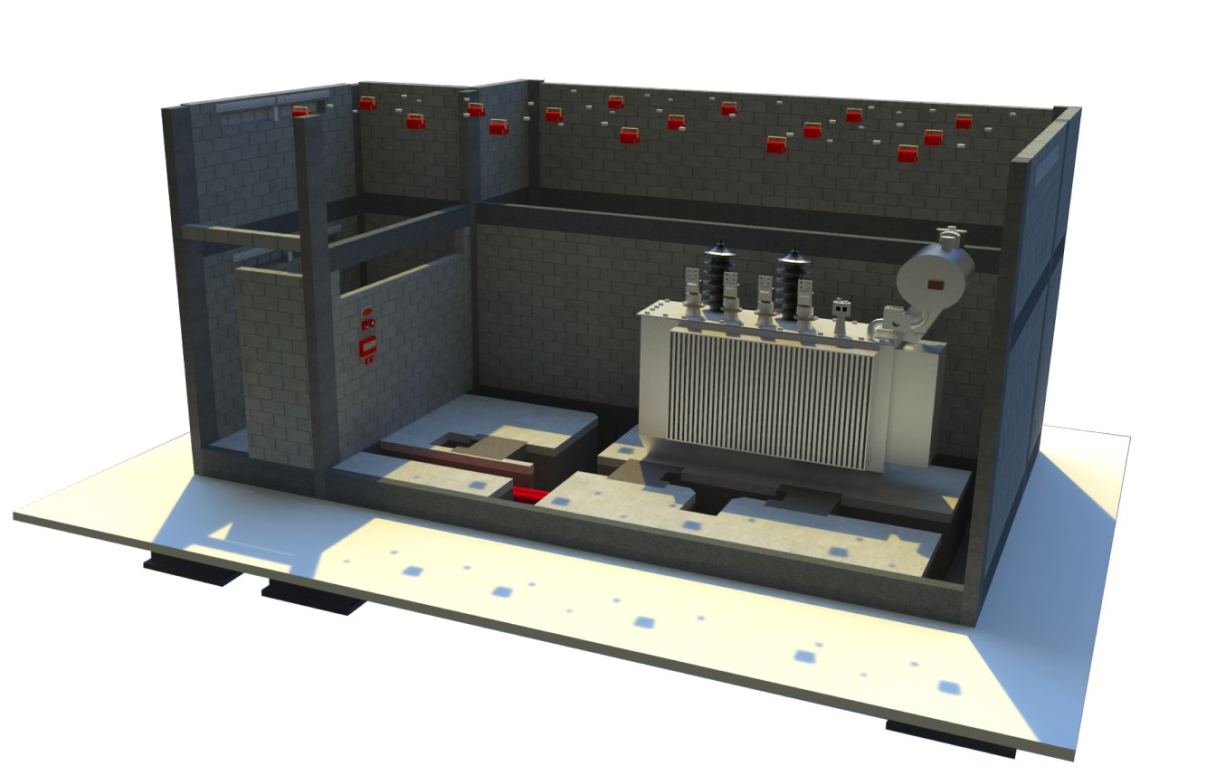
Power Transformer System Design
FirePro's aerosol fire suppression system furnishes a reliable, cutting-edge solution for protecting critical infrastructure from the perils of power transformer fires.
Power transformers which are filled with an insulating liquid, usually mineral oil, for cooling and arc prevention, constitute a significant fire hazard. When overheated past its flash point, the combustible liquid will result in an intense fire and explosion that can cause irreparable damages to the transformer as well as to adjacent structure and equipment.
Fire Hazard Causes for Power Transformers
Overheating is one of the most common causes of power transformer fires, often occurring as a result of insulation failure or inadequate cooling systems. When transformers are pushed beyond their limits, the resulting increase in temperature can cause components to malfunction, leading to catastrophic failures that can result in fires.
Overheating is one of the most common causes of power transformer fires, often occurring as a result of insulation failure or inadequate cooling systems. When transformers are pushed beyond their limits, the resulting increase in temperature can cause components to malfunction, leading to catastrophic failures that can result in fires. Short-circuiting is another frequent cause of power transformer fires, as electrical current is allowed to flow unchecked through the transformer's components. This can lead to an increase in temperature and a buildup of heat, which can ultimately result in the ignition of nearby combustible materials and the onset of a fire.
Oil leakage is a third major cause of power transformer fires, as the flammable properties of transformer oil can create a serious fire hazard if it leaks or spills from the transformer. If the oil comes into contact with a source of heat or flame, it can easily ignite, leading to a potentially catastrophic fire.
Overheating is one of the most common causes of power transformer fires, often occurring as a result of insulation failure or inadequate cooling systems. When transformers are pushed beyond their limits, the resulting increase in temperature can cause components to malfunction, leading to catastrophic failures that can result in fires. Short-circuiting is another frequent cause of power transformer fires, as electrical current is allowed to flow unchecked through the transformer's components. This can lead to an increase in temperature and a buildup of heat, which can ultimately result in the ignition of nearby combustible materials and the onset of a fire. Oil leakage is a third major cause of power transformer fires, as the flammable properties of transformer oil can create a serious fire hazard if it leaks or spills from the transformer. If the oil comes into contact with a source of heat or flame, it can easily ignite, leading to a potentially catastrophic fire. Lightning strikes are a less common but still significant cause of power transformer fires, as the massive electrical currents generated by lightning strikes can cause serious damage to transformers and other electrical equipment. The resulting electrical surges and heat can cause insulation failures or component damage, which can ultimately lead to a transformer fire.
Fire Suppression Challenges
Openings
Ventilation openings help to maintain temperatures inside the enclosure within certain design limits. These openings pose a serious challenge for fire suppression technologies that require a completely sealed enclosure to be effective.
Classes of Fire
Power transformers can be subject to fires involving a combination of Class A combustible materials (wires and insulating material), Class B flammable liquids and gases (generator fuel), and Class C electrical equipment. Fire suppression systems must therefore be suitably certified for these classes of fire.
Remote Locations
In some cases, substations are constructed in isolated areas to benefit from the power source or minimise the potential for fire and other hazards. For remotely located substations, the installation and maintenance of the necessary fire suppression systems can be a complex and time-consuming process.
Unmanned Operations
When substations are not manned, there is a greater risk of fires due to lack of monitoring and maintenance. Additionally, the substation may be vulnerable to other hazards, such as unauthorised access or vandalism.
Advantages
Suitable for Electrical Panels
Our fire suppression technology is specifically designed to be suitable for electrical panels.
No Pipes or Nozzles
Our fire suppression technology is specifically designed to be suitable for electrical panels.
15-Year Product Life
Our fire suppression technology is specifically designed to be suitable for electrical panels.
Pressureless
Our fire suppression technology is specifically designed to be suitable for electrical panels.
Minimal Maintenance
Our fire suppression technology is specifically designed to be suitable for electrical panels.
Allowable Deviation of Small Openings in Enclosures
Our fire suppression technology is specifically designed to be suitable for electrical panels.
Easy and Fast Installation
Our fire suppression technology is specifically designed to be suitable for electrical panels.
Extreme Conditions (from -54 to +54 degrees Celsius)
Our fire suppression technology is specifically designed to be suitable for electrical panels.
Space and Weight Savings
Our fire suppression technology is specifically designed to be suitable for electrical panels.
Why FirePro.
Leakage
FirePro fire suppression technology is capable of handling small openings in the enclosure that can lead to agent loss.
Compactness
Thanks to their compact size, FirePro generators are an ideal solution for electrical cabinets, as they can fit inside the panel, providing direct protection. The smallest generator in the FirePro series has dimensions of 32 mm (diameter) and 180 mm (height).
Easy to install in new or retrofit projects.
FirePro generators are an "all-in-one" container and are equivalent to the agent storage tank, piping, and nozzles of a pressurized gas system. They are installed directly in the hazard enclosure, without the need for additional space for the system.